For over a decade now, I’ve had the privilege of coaching individuals and teams in numerous organizations, guiding them through a practice I’ve come to call Personal Capacity Planning – and more recently Personal & Team Capacity Planning. It’s a method that in my empirical experience boosts productivity and brings an increased sense of control to how teams manage their work. This journey, from its beginnings to its application today, has become deeply intertwined with the principles and practices of the Kanban method.
The seed of an idea: supporting the implementation of Lean
My first steps into what would become Personal & Team Capacity Planning date back to 2009-2010, when I was applying Lean as a Delivery Manager at a technology company. Back then, it wasn’t a formalized practice with a name; I simply started doing personal capacity planning on a sheet of paper. It was a pragmatic, empirical approach, initially not much more than an exercise in understanding personal time usage and get my teams to become aware of the actual fact that their personal capacity was limited.

My understanding of this concept deepened significantly over time and after I began learning about Kanban and the Kanban Maturity Model (KMM). At some stage it became clear how this personal reflection on capacity could be a tool for organizations. I’ve briefly reported in my first article on the topic this initial evolution.
Evolving with Kanban: defining WIP limits
As my knowledge of Kanban grew, so did the practice. It evolved specifically to help define Work In Progress (WIP) limits. This was a crucial leap, recognizing that the need for WIP limits stems directly from the limited production capacity of a team, which in turn is constrained by the limited capacity of each individual member. My second article delved into how Personal Capacity Planning aids in defining these crucial limits.
I have also been inspired by the exchange of ideas with Susanne Bartel of Flow Hamburg on this topic, as well as by a presentation that she gave at the Agile & Kanban Coaching Exchange. This presentation made me aware of the capacity Token System, a concept that I have now fully integrated into my practice.
The current landscape: capacity tokens and flow balancing
Today, I find this practice instrumental in supporting established teams working across two or more workflows. A common challenge for such organisations, particularly when starting with Kanban, is allocating resources across their various workstreams.
Implementing Kanban can be challenging for teams working on multiple workflows, especially if these workflows differ significantly or are constrained by separate legacy systems. Although there is often a desire to integrate flows, this is rarely practical due to differing operational needs or incompatible tools. Teams may also resist adopting new systems, like Kanban boards, perceiving them as an added reporting burden. A more pragmatic strategy is to embed Kanban principles and practices directly into the existing workflow infrastructure, effectively transforming current systems into Kanban-compatible environments without the need for entirely new platforms.
In the next chapter, I will delve deeper into these ideas, focusing on the practical application of Kanban within organisations already managing multiple workflows. I’ll describe how I support these teams in allocating resources more effectively. The process begins by mapping out a ‘hypothetical typical week’—first at the individual level, then aggregated by team. Time slots are converted into ‘capacity tokens’, which are then distributed across the various workflows. This method helps balance workloads and optimise the use of resources. Ultimately, the aim is to stabilise the overall system by applying WIP limits to individual flows and managing capacity across them, ensuring a more efficient and harmonious distribution of work.
The practical implementation: Personal & Team Capacity Planning at work
This is how Personal & Team Capacity Planning works in practice:
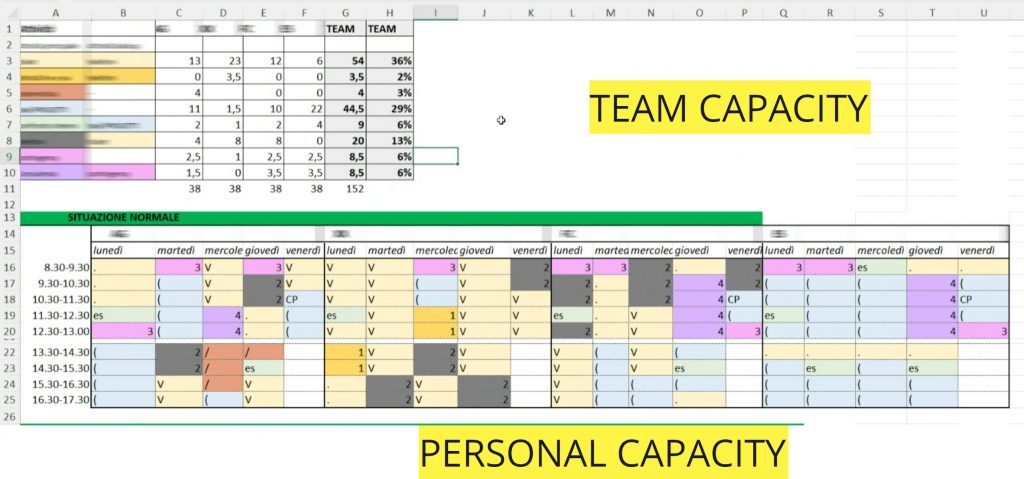
- Imagining the week: I ask teams to envision their typical theoretical week, much like the descriptions in my earlier articles. This involves each member jotting down a guess of their weekly capacity, almost like a schedule forecast divided into slots. Crucially, I always emphasize that it’s not a schedule, but a tool for reflection on how they use their time and to acknowledge the physical limits of their capacity.
- From slots to capacity tokens: Once each team member has guessed their slots, the total capacity for the team is calculated and transformed into ‘capacity tokens‘. It’s important to establish a connection between individual slots and collective team tokens to emphasise that each individual contributes to the team, and that the team’s collective capacity is what matters.
- Strategic allocation and WIP limits: During Kanban cadences, we collectively reason about how to assign these capacity tokens to the various workflows. Based on the capacity assigned to each flow, we then define their respective WIP limits. The goal is to balance the flows, preventing situations where some flows have too much capacity while others have too little. If we observe a flow underperforming while others excel, we can visually re-balance by shifting capacity. This shift intuitively signals the need to adjust WIP limits to “throttle” over-resourced flows and give space to those that need more capacity. It’s an empirical equilibrium where WIP limits not only stabilize the flow but also play a dual role in assigning capacity across parallel flows, thus making the entire system more stable and reliable.

The practice across the Kanban Maturity Model levels
I primarily introduce the Personal & Team Capacity Planning practice within STATIK (System Thinking Approach to Implementing Kanban) when analysing current capacity. Retrospectively, I have seen the practice evolve significantly across different maturity levels within an organisation, as defined by the Kanban Maturity Model (KMM).
At maturity level zero (ML0), where the organization is oblivious and individuals operate independently, this practice serves to help people understand their work. The goal is to encourage a shift from an individualistic approach to one where individuals begin to work as a team at ML1. To facilitate this transition, each team member identifies their personal ‘capacity tokens’ and how they assign them. This allows for a collective discussion among team members to redistribute these tokens, now considered the team’s overall capacity, onto a unified workflow.
Moving from ML1 to ML2, this practice shifts its focus to the customer. The team collectively decides how to allocate their tokens across activities and workflows to improve customer service. This is particularly important when dealing with different workflows that are difficult to unify, as these can cause problems and push people back towards managing systems individually or in silos. The objective at this stage is to manage systems in a unified way, which is vital for a team to progress from ML1 to ML2.
The same approach applies to the transition from ML2 to ML3, although different work teams may be involved. While not always necessary, rebalancing workloads within a team can still be beneficial. At ML3, the focus is on aligning workflows into an overall service system. This may entail reallocating resources by transferring tokens from one team’s workflow(s) to another’s, provided it contributes to the overall rebalancing of all flows.
Finally, once the system has reached ML3 and is balanced across the entire service, the focus shifts to managing demand variability and risk hedging to reach ML4. This involves the ability to add tokens, meaning capacity is reserved that doesn’t actually exist, but is brought in during peak periods. For example, during seasonal peaks (such as September and June for an HR department I am coaching), additional resources (e.g. part-time employees from other departments who are willing to work extra hours) are utilised as a ‘reserve team‘. These additional people correspond to the extra tokens made available when needed. This concept is integrated into, and expands upon, the practice of using classes of booking in a dynamic reservation system (MF 4.6) , enabling the reservation of capacity that is not yet available.
This creates a continuum of capacity management systems, from ML0 to ML4 and beyond.
Addressing complex realities: multiple workflows and legacy systems
The core premise of this approach is that teams typically work across multiple workflows. While it might be possible to manage a single team with different work item types within one flow in some situations, this is often not feasible. These flows can be intrinsically different, with unique steps and dynamics, or they may be tied to disparate legacy workflow systems. In such cases, it is common to resist the use of new Kanban boards because data is already held in existing systems. My strategy is to leverage these existing systems and transform them into a Kanban system, in line with the Kanban principle of ‘start with what you do now’.
The three steps to empowered teams
The method is highly empirical and pragmatic, designed to avoid time-consuming estimates or rigid scheduling.
- Step one: look for weekly patterns. Rather than making forecasts, we analyse what has been done on average over the last few weeks or simply track activities for two to three weeks. This reveals how loads are typically distributed. Even in less mature organisations (ML0 to ML2), it is fascinating how sensible patterns appear, as if people instinctively create predictable routines to compensate for inconsistencies. This remains valuable even at higher maturity levels.
- Step two: adjust the patterns to evolve the workflow. This instinctive tendency can be used to stabilise and evolve workflows. I have observed that allocating capacity tokens to workflows and ensuring the team understands their importance helps stabilise individual behaviour and consequently the system. Combining this with other Kanban practices, such as visualising work, collecting metrics and identifying improvements, enables teams to collectively adjust capacity patterns and improve workflows. Kanban cadences, such as the Team Kanban Meeting and the Service Delivery Review, provide a platform for discussing and sharing safe-to-fail experiments for adjusting capacity patterns. This leads to stabilised and optimised workflows over time.
- Step three: reserve capacity as you see fit. This adjustment and rebalancing process often involves allocating specific capacity. When I first implemented this process in 2011 as a Delivery Manager, the main issue was the sharing of resources between projects and maintenance. We created capacity slots to prevent conflicts and ensure that project capacity was realistic. Since then, this approach has helped in various scenarios, from applying Scrum with shared team members to balancing workloads for support and development teams.
The true impact: stability and self-mastery
The initial reaction to introducing this practice is often suspicion – a feeling that I want to ‘cage’ and control the team. However, over time, teams invariably discover that it’s the opposite: an autonomously managed method that fosters stability and predictability in their working system, irrespective of external pressures.
Greater stability and predictability mean that individuals and teams gain increasing control over the service levels they offer their customers. This isn’t about limitation; it’s about empowerment. It relieves external pressure and allows teams to truly master their own workflows. This counterintuitive concept truly clicks only when experienced, as it integrates seamlessly with the Kanban Method and its core principles.
Sources
- David J. Anderson, Kanban: Successful Evolutionary Change for Your Technology Business, Blue Hole Press, 2010
- David J. Anderson, Teodora Bozheva, Kanban Maturity Model: A Map to Organizational Agility, Resilience, and Reinvention – 2nd Edition, Kanban University Press, 2021
- Susanne Bartel, Managing Hybrid Projects with Kanban, YouTube Channel of Agile & Kanban Coaching Exchange, 2024
- Marco Re, A Kanban-like system successfully implemented at Doxee in 2010-2012, Kanban+ portal of Kanban University, 2023
- Marco Re, Personal Capacity Planning: a practice that boosts Kanban teams productivity, issued on this blog, 2024
- Marco Re, An update on Personal Capacity Planning: a practice that boosts Kanban teams productivity, issued on this blog, 2024